Genetic Material
Have you ever read
Treasure Island or watched one of early
Pirates of the Caribbean movies (when they were still about pirates in the Caribbean)?
What is the one feature of every treasure map?
X marks the spot.
In biochemistry, we are often on a similar scavenger hunt (as an aside, if you are joining a social organization or a sports team, and they send you on a scavenger hunt which involves quests that might be dangerous, embarassing or illegal, that is hazing and should be reported to a member of the administration, faculty or staff). Biochemical molecules are large and interact with one another is subtle ways. When considering the interaction of two molecules, it is often only a very small subset of those molecules which directly contact one another. We often use the term "bind" to describe that interaction.
So, let's see if we can find that spot marked with an X (or at least the binding site for a protein on a DNA molecule).
As a general introduction, a homeodomain is an α–helical structure with a classic helix-turn-helix structure known to bind in a sequence-specific fashion to DNA. Homeodomains are coded for by homeobox genes and function as transcription factors. They play a critical role in basic body-plan formation during animal development (the homeo- moniker refers to the transformation of one organ into another by due to mutation or failed gene expression. The first identification of homeobox genes was in Drosophila melanogaster (the fruit fly) where the legs of the fly developed on the head, not the thorax where they are normally found. Ouch!
The antennapedia (legs where the antenna should be) phenotype looks like this (definitely not normal).
The authors are interested in similar type gene, sine oculis (so), which is involved in eye development in the fly. They are taking three subsets of the gene and expressing those sequences in E. coli, purifying the peptides and then testing them against a DNA sequence to discover if and where they bind to that DNA.
The big question you might be asking is, "can you divide a protein like that?"
The answer is, "it depends."
The SO protein (gene, PROTEIN note the capitalization convention) is large at 416 amino acids. As a general rule, large proteins are made of smaller protein pieces called domains. Those domains often adopt their structure independently. If you express part of a gene sequence along the corresponding domain structure, it will often workout alright. Note Figure 2 is, more or less, all about showing you that their protein fragments are well-behaved.
Again your pre–writing assignment is to, in no more than 250 words, summarize this work. Think about the fundamental question at play, the system used to address that question, the results and what those results mean with regard to the fundamental question.
Purifying DNA
The target for DNA isolation is the strawberry fruit.
"Why the strawberry fruit?"
Glad you asked. The short answer is that the strawberry fruit is octoploid.
"What does that mean?"
Again, glad you asked. Ploidy is the biological term for the number of complete copies of genetic information in a cell. For a mammalian vertebrate (you're one) a typical set of genetic information is described as diploid. Two sets of genetic information, one from dad, one from mom. And yes, you guessed it, germ cells are haploid (one copy) such that the joining of two gametes makes a new diploid organism.
While the situation for human somatic cells is pretty stable at diploid (there are some genetic disorders like Kleinfelter or Down syndrome in which there is an extra copy of one chromosome, humans have twenty–three, but you don't generally find higher than diploid numbers in humans), polyploidy (more than two copies) is common in plants. For us, the cultivated strawberry fruit is octoploid, eight copies of each of the seven chromosomes. And, if you'd like to purify a large amount of something, you either need to start with a large amount of tissue, or go for tissue that has a large amount of what you're after. Thus the strawberry fruit is an ideal starting point for DNA purification.
Purifying Strawberry DNA
Equipment:
- Semi–micro blender
- Conical tubes, 3 x 50 mL, 1 x 15 mL
Reagents:
- Strawberry
- Lysis buffer
- Chilled 95% ethanol
- Tare a weigh boat and add strawberry pieces until you have 2 to 4 grams of strawberry fruit, pieces are just fine and it doesn't have to be all from the same berry.
- Add the strawberry to a semi-micro blender along with 10 mL of lysis buffer.
- Blend the strawberry and lysis buffer for 60 seconds.
- Transfer the homogenate to a 50 mL conical tube and allow the pulverized strawberry to rest in lysis buffer for 2 minutes.
- Spin the homogenate at 9500g for 10 minutes at 4 oC.
- Pour the upper strawberry extract off the fibrous strawberry remnants into 30 mL of ice cold ethanol in a 50 mL conical tube and allow it to sit for five minutes. During this time the DNA will condense (precipitate) and rise to the surface.
- Transfer the DNA mass (catching it with a spatula works well) to a second 50 mL conical tube and wash with 30 mL of cold ethanol. The purpose of this rinse is to remove red fruit pigment from the DNA. Allow the DNA to sit in this ethanol for five minutes.
- Remove the DNA to a 15 mL conical tube containing 10 mL cold ethanol.
Questions
- The physical bases for isolating DNA was changing the solvent from water to ethanol (CH3CH2OH), which precipitates the DNA. Considering the structure of DNA shown below, why might you expect it to be less soluble in a less polar solvent? (Remember the mantra of high school chemistry—Like dissolves like.)
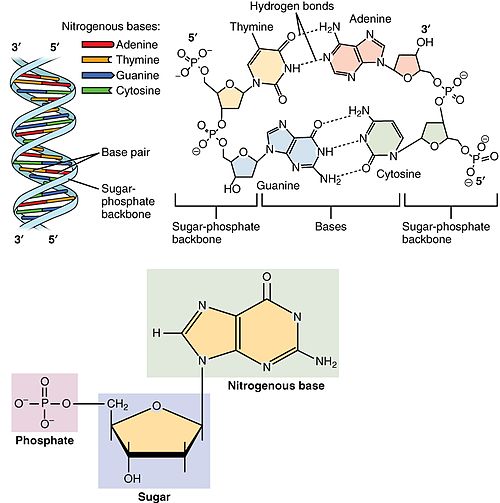
- The above question has some subtelties as the monomer unit of DNA (nucleotide monophosphate, lower left above) has both polar and nonpolar portions. Rank the three portions (nitrogenous base, sugar and phosphate) from most polar to least polar. In the structure of double strand DNA, where do you find the more polar parts (inside or outside), where do you find the less polar parts?
- While DNA is soluble in aqueous solution, double strand DNA has issues in distilled water. Why?
Laboratory Report
Provide answers to the questions above.
Last updated 09 March, 2026.
Page generated in 5 milliseconds.


